About the Author: Nate Wheeler is the founder of weCreate, a digital marketing agency that works exclusively with manufacturers. A USMC Infantry veteran with an MBA and 15+ years of marketing experience, Nate has spoken at events for the U.S. Department of Commerce, the Manufacturer & Business Association, the NTMA, and the NWIRC. He is the founder of Tristate Manufacturers Marketplace and host of the Manufacturing Insiders podcast.
Five years ago, a young sales manager named Troy got an assignment that made him uncomfortable.
His company — a mid-sized precision industrial fabricator — had been coasting on repeat orders from a handful of longtime customers for years. Sales were down. New business was nearly nonexistent. The owner handed Troy a vague mandate: “Get the website updated.”
Troy did not really know what that meant. He did not know what to ask for, what success looked like, or whether a new website would actually move the needle on the sales problem he was staring at. He just knew the site looked dated and that something had to change.
So he did what any of us would do. He Googled it.
He found weCreate, read through the site, and got on a call with me (Nate Wheeler). What he expected was a pitch for a new design. What he got instead was a completely different way of thinking about his sales problem.
I walked Troy through something that had become obvious to me after years of working with manufacturers, but that stopped him cold: your website is not a brochure you send people to. It is a salesperson — one that works 24 hours a day, never calls in sick, and can be talking to dozens of qualified buyers simultaneously. More importantly, I told him, the buyers in his industry were already searching online for exactly what his company made. Every day that his company did not appear at the top of those searches was a day a competitor got that call instead.
Troy bought in. Then his team bought in (I made that sound easy). We rebuilt the site, launched a focused industrial SEO program, and got to work.
Over the next four years, that program generated millions in business and $2.8 million in tracked leads in the most recent year alone — inbound inquiries from buyers Troy never would have reached through cold calls or trade shows. Then, about a year ago, something happened that nobody on that first call could have predicted: they closed a deal with SpaceX.
Today, Troy’s company is turning away business because they cannot keep up with demand.
That is not a marketing story. That is what happens when a manufacturer becomes genuinely visible to the right buyers at the right moment. There is no better way for industrial manufacturers to grow than SEO when done correctly.
If you are reading this and wondering whether something like that is possible for your company, keep reading. The rest of this guide explains exactly how industrial SEO works, what actually drives results, and how it compares to every other option available to you. Near the end, you’ll find a sample 12 Month SEO/AEO calendar you can adapt to your company to start producing new leads, or, have a conversation with us to find out how we can help.

Before getting into the details, here are the seven rules manufacturers winning in search and AI visibility are following in 2026.
The rest of this guide walks through each of these rules in detail, uses real manufacturing examples, and gives a realistic picture of what industrial SEO can and cannot do for your company.
How would you feel about sending a salesperson to meet prospects if he doesn’t know what machinery you have in your shop, what materials you work with, who your ideal customer is, or why your company is the best at what it does? Sounds crazy right? Well that’s exactly what industrial manufacturers do with their best sales tool - their website. These industrial companies haven’t put thought into SEO, which is more than a marketing technique, it’s equipping your best “salesperson” - the one that never sleeps - with the tools it needs to succeed.
Search engine optimization for industrial manufacturers is the combination of on-site improvements and off-site authority building that causes your website to appear at the top of Google — and increasingly AI-powered search tools — when a buyer searches for what you make or do.
In plain terms: your ideal customer types something into Google, ChatGPT, or Grok. Industrial SEO/AEO determines whether they find you or your competitor.
According to Semrush's B2B Marketing Statistics report, 66% of B2B buyers use organic search to research suppliers before ever contacting a sales rep. And Forrester's State of Business Buying research found that buyers are already 70% through their decision process before they reach out to a vendor. If you're not visible in search at that moment, you simply don't exist to them.
The median SEO ROI for manufacturing companies is often far higher than most manufacturers expect, which is why SEO consistently outperforms short-term channels when it is executed well over time.
The first rule matters because most industrial websites are still built like brochures. They talk about the company, list a few services, add some photos, and assume that is enough. It is not. A high-performing industrial website needs to act like a salesperson that is always available, always clear, and always positioned around buyer intent.
Every industrial SEO program lives or dies on two interconnected disciplines: on-page SEO and off-page SEO. Understanding both — and the relationship between them — is the foundation of everything else.
On-page SEO is the architecture of your website. It's how your pages are structured so that Google and other search engines can clearly understand what each page is about, what searches it should appear for, and how valuable it is to a real reader.
The most important on-page elements for industrial manufacturers:
This is where a lot of manufacturers go wrong. They create broad pages like “Capabilities,” “Industries Served,” or “What We Do,” but never build the deeper pages that match how a buyer actually searches. Engineers and procurement people do not search in vague brand language. They search in process language, material language, certification language, geography, and application-specific phrasing.
“Press manufacturer” is vague. “Hydraulic platen press manufacturer” is much better. “Machine shop” is broad. “AS9100 CNC machining for aerospace components” is far more useful.
The most common on-page mistake is a site that is entirely self-promotional — “we offer this, we provide that” — without providing genuinely useful technical information. The companies that rank and convert are the ones that also educate. When buyers can see that you understand their process, tolerances, materials, or application, they trust you more.
Spec sheets, material data sheets, process guides, FAQs, tolerance references, and buyer education content are some of the most underused assets in industrial SEO.
Too many manufacturers upload these as raw PDFs and assume they are doing content marketing. In reality, structured HTML pages built around those assets usually perform much better in search because they give Google and AI systems more context and more crawlable content.
If your site has technical knowledge buried in documents, that knowledge should be turned into pages that can rank. This often includes:
This is one of the easiest ways for an industrial company to create truly useful content without inventing fluffy blog topics. The expertise is already in the business. The challenge is packaging it in a way that buyers — and search engines — can understand.
Off-page SEO is the part most manufacturers underestimate — and the reason most DIY SEO efforts eventually stall. Over the years, through hundreds of conversations with industrial companies and internal marketing teams, never once, NOT ONCE, have I come across a team that understood enough about off-page to be reliably effective.
Even a perfectly optimized website will struggle to rank for competitive industrial terms without external authority signals, primarily backlinks. A backlink is a link from another website pointing to yours. In Google’s evaluation model, each quality backlink functions like a credibility vote.
Not all backlinks are equal. The factors that determine a link’s value include:
You can assess your own site's backlink profile — and benchmark against competitors — using two tools we rely on:
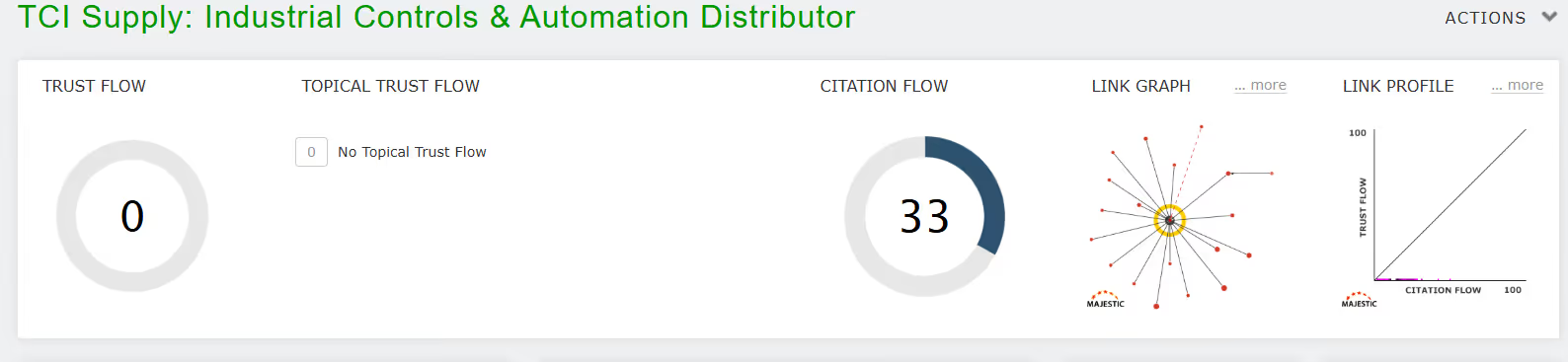
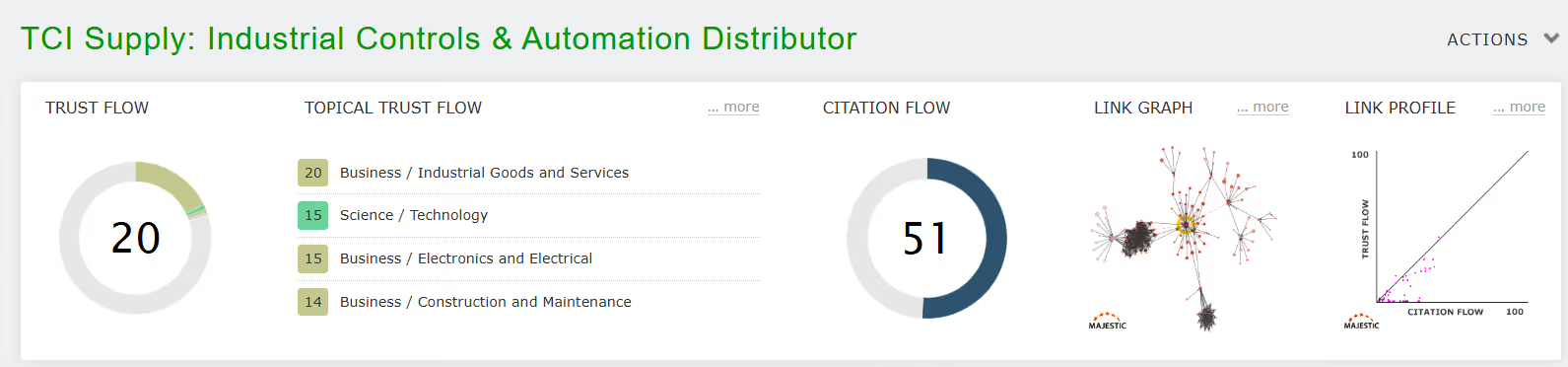
For industrial manufacturers, the highest-value backlink sources fall into three tiers.
Links from PMPA, NTMA, AMT, your regional MEP center, and the Manufacturer & Business Association carry significant Topical Trust Flow in the "Business/Industrial Goods and Services" niche — exactly where you want it. Membership listings, speaking engagements, and contributed articles in these networks are among the highest-value link-building activities available to any manufacturer.
The most scalable long-term link acquisition strategy is creating technical content so genuinely useful that trade publications, industry blogs, and peer organizations naturally reference it. Process guides, material comparison charts, design-for-manufacturability resources, and tolerance references earn links organically — while simultaneously driving direct search traffic.
This is the section most industrial SEO guides haven't caught up to yet — which is precisely why it belongs here.
Tools like Google's AI Overviews, ChatGPT, Perplexity, and other AI search tools are now actively used by engineers, sourcing teams, and procurement managers to identify and shortlist suppliers.
Forrester found that 95% of B2B buyers expect to use generative AI in their purchasing process. This isn't coming — it's happening in your buyers' offices right now.
What makes an industrial manufacturer show up in AI-generated results?
The practical takeaway: everything that has always made industrial SEO effective — real expertise, quality backlinks, specific technical content — now also makes you visible in AI-generated search results. The surface area has expanded. The fundamentals haven't changed.
This is the comparison most manufacturers need before they commit to a direction. We've used and tested every channel listed below — both for weCreate's own growth and for clients across dozens of manufacturing verticals. Here's the honest, data-backed picture.
SEO-generated leads typically close at much higher rates than outbound leads because the buyer is already looking for what you make. Outbound methods like cold calling and direct outreach still have value, but they usually begin much earlier in the buying journey and require much more effort to convert.
Outsourced cold calling is a legitimate option, but the investment and timeline are often presented unrealistically. A good prospecting contractor with manufacturing experience can easily cost $40,000–$70,000 per year. Those leads are often early-stage and relationship-driven, which means the true payoff may take years.
Trade shows still matter in certain sectors, especially when relationships and product demonstration are central. But from a pure lead-generation ROI standpoint, they are difficult to justify as the main growth engine. Once the event is over, the spend is gone.
ThomasNet, MFG.com, RFQUSA, and similar platforms can be genuinely useful, especially early in a program when your own site needs authority support. The key distinction is that a directory drives buyers to their platform first. SEO drives buyers directly to your website.
That difference compounds over time.
For a manufacturer doing roughly $1 million to $10 million in revenue and trying to grow aggressively, a practical annual marketing budget often looks something like this.
Not every manufacturer needs to pursue all of these simultaneously. The point is to compare options honestly and allocate budget based on long-term value, not just short-term visibility.
This section matters because the market is saturated with firms selling things that look like SEO but aren't.
There was a time when automated tools could generate thousands of low-quality backlinks and briefly boost rankings. That era is over. Search engines now evaluate the relevance, authority, and topical alignment of links far more carefully.
Be skeptical of any firm that pitches a flat monthly package with a fixed number of social signals, press releases, or generic submissions. Those packages are easy to automate and easy to report on, but they rarely reflect the real work that moves industrial rankings.
Social media has value for visibility and relationship-building, but it is not a substitute for SEO. Strong social presence may correlate with good rankings because better companies often invest in content and branding overall. That does not mean social activity itself is doing the ranking work.
This is the most important expectation to set correctly. Industrial SEO is a compounding investment. Many manufacturers begin to see meaningful keyword movement in 3–6 months. The deeper compounding effect — where authority builds, rankings broaden, and traffic grows across many clusters — often becomes visible in the 12–18 month range and continues from there.

The chart above is a great example of timeline. It shows blue line (clicks), and purple line (impressions or views) - with clicks being the important measure of people visiting the website. The SEO started in the campaign in January of ‘25. Notice the slow buildup before takeoff. This is where a lot of manufacturers get impatient too early. SEO does not usually work like paid ads. It builds slowly, then unevenly, then powerfully. The compounding is the whole point. So how do you know if an SEO agency is blowing smoke, or if that slow first 6 months is normal? First, we did see a 20% increase in traffic in the first 6 months, so there were results to demonstrate. Secondly, a good agency should be capable of explaining the likely trajectory of a campaign, and what signals you’ll see before leads start flowing. Monthly (or regular) face-to-face meetings are part of a good agency’s process.
The industrial marketing space is crowded with generalist agencies that add “manufacturing” to a services page without truly understanding the space. A legitimate industrial SEO firm should meet five standards.
The manufacturers winning consistently in 2026 are not doing one thing well in isolation. They are running a coordinated program:
Troy’s company did not close a SpaceX deal because they ran a campaign. They closed it because over several years they built the kind of search visibility and online credibility that puts a manufacturer in front of buyers it would never reach through cold calls or trade shows alone.
That is what industrial SEO, done right, actually produces.
Ready to See What This Looks Like for Your Company?
A proper review should audit your current search visibility, benchmark you against top competitors, and identify where the real opportunities are.
Get Your Free SEO Audit →
How long does industrial SEO take to produce results?
Many manufacturers begin to see meaningful keyword movement in 3–6 months. The compounding effect becomes much more obvious in the 12–18 month range, especially when the program includes both technical site work and off-page authority growth.
What keywords should an industrial manufacturer target?
Start with specific capabilities, materials, certifications, and geography rather than generic broad terms. “ITAR certified CNC machining Pennsylvania” is usually far more useful than “machine shop.” The right keyword set depends on real search behavior, not guesswork.
How much should industrial SEO cost?
Effective programs for manufacturers often fall into the $2,000–$4,000 per month range depending on competition, site size, and content volume. Significantly cheaper programs often do not support the quality backlink work and technical content needed to move difficult industrial terms.
Does a company need a new website to do SEO?
Not always. A technically sound site can often be optimized. But if the current platform limits metadata control, performs poorly, or lacks the flexibility needed for capability-focused content, rebuilding may be the more efficient long-term move.
What about paid search alongside SEO?
Paid search can create visibility immediately while organic SEO builds. It can be useful for high-value terms with clear ROI. But long term, organic SEO typically delivers better returns because it does not stop the moment the budget stops.
Is social media helpful for industrial companies?
We’ve found that social media is not generally as predictably useful as proven techniques like SEO for generating leads and revenue. We’ll never say no to any idea you have to internally promote your company, and encouraging your employees to promote projects on social media will likely eventually produce opportunities.
Does social media help with off-page SEO?
The short answer is “no”. The longer answer is that some search engine algorithms put slight weight on social signals, and it’s certainly not going to hurt.
Why should I work with weCreate for SEO?
weCreate has an unbeatable track record of success generating revenue for industrial companies. You won’t meet a team that has our combination of passion and knowledge of manufacturing, paired with the technical expertise to make your campaign a success.