



The short answer: The machine shops and contract manufacturers winning new business in 2026 aren't cold calling their way to growth — they're being found. Buyers are researching online, vetting suppliers digitally, and in many cases asking AI tools for recommendations before they ever contact a sales rep. This guide covers what actually works, drawn from a decade of hands-on experience building marketing programs for shops just like yours.
A number of years ago, the owner of a small father/son machine shop with 5 employees was struggling. Marvin — the father — was in his late 60s and had run a successful business for many years. He had a state-of-the-art Okuma 5-axis machine, a few 3-axis machines, and a handful of manual machines still earning their keep. The problem was simple: with a very expensive machining center, you need to keep it busy to pay for it.
The industry was changing. The handshake deals that Marvin had survived on for decades were becoming more and more rare. He was considering shutting his doors, but he wasn't ready to give up. So one day he did a Google search looking for a marketing company with experience helping machine shops. He found weCreate and gave us a call.
We built him a website that showed his credibility, outlined his core competencies, and made him look like the serious shop he was. We wrote content targeting searches like "custom fixturing manufacturer" and "5-axis machining services." Then we got to work on SEO. Today — nearly a decade later — Marvin's machining business is thriving. He regularly gets inbound leads because we built it right, and he invested in an ongoing SEO program that keeps him visible when buyers are searching for exactly what he offers.
Marvin's story isn't unusual. It's what happens when a good shop finally gets visible.

Here's the reality that changes everything about how you should be marketing your shop: by the time a procurement manager or engineer contacts a supplier, they're already 70% through their buying process. They've done the research. They've shortlisted candidates. They may have already ruled you out — or ruled you in — based entirely on what they found online.
According to Semrush's B2B buyer research, 66% of B2B buyers use internet search to find information before making a purchase — putting organic search ahead of online ads, trade publications, and sales outreach. And Forrester's State of Business Buying report found that nearly 95% of B2B buyers expect to use generative AI tools to support their purchasing decisions in the near future. That last number should get your attention.
The practical implication for a machine shop or contract manufacturer is this: your marketing program isn't about interrupting buyers — it's about being clearly visible and credible when they come looking. The strategies below are designed to make that happen.
The reason the term "sales funnel" exists is that the traditional model involved knocking on doors and making hundreds of cold calls to find warm leads. Those leads were then nurtured over months of wining and dining before a purchase order showed up. That model isn't 100% dead — it's just expensive, slow, and increasingly ineffective when buyers have already done their homework online before the first conversation.
The good news is that inbound lead generation — being found rather than doing the finding — compounds over time. Content marketing costs 62% less than traditional outbound while generating 3x more leads, and those leads are 61% more likely to convert into sales than outbound-sourced ones. For a machine shop with a limited marketing budget, that math matters.
This sounds obvious, but the bar is higher than most shop owners realize. A basic web presence isn't enough. Buyers evaluating contract manufacturers are looking for signals that you're capable, credible, and low-risk — and they're making those judgments quickly. Here's what your website must communicate clearly:
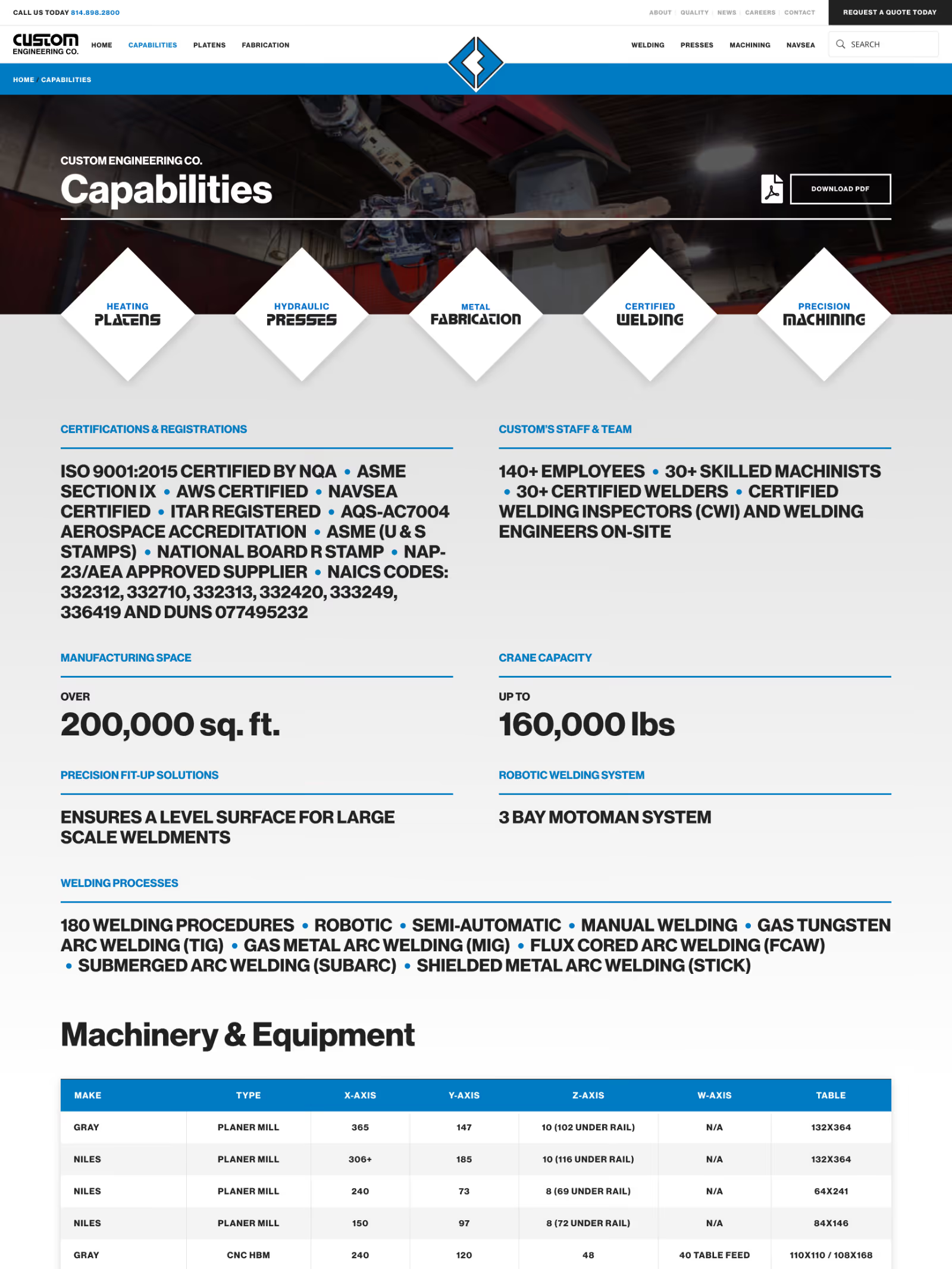
One thing we've learned from building websites for machine shops across multiple industries: specificity converts. A buyer searching for a shop that handles high-volume tube cutting for aerospace applications doesn't want to call five generic "full-service machine shops" to find out who can actually do it. The shop that answers that question on their website — clearly, with supporting technical detail — wins the RFQ.
SEO is not a quick fix. But it is the most durable, highest-return channel available to a machine shop. Research puts SEO's average ROI for B2B companies at 748% — higher than any other digital channel. The reason: unlike paid ads that stop producing the moment you stop paying, SEO compounds. A well-optimized page can generate leads for years.
The key for machine shops is avoiding the trap of competing for generic, high-volume terms like "CNC machine shop" or "contract manufacturer." Those terms are dominated by large directories and national players. The real opportunity is in niche, high-intent keyword clusters that match your specific capabilities and the buyers you actually want:
Each of these keyword sets has real search volume from buyers who are far along in their procurement process. An ongoing SEO program systematically builds coverage across these clusters — and each new piece of content adds a new thread of visibility that generates leads independently.
One (of too many to count!) recent result from our own client work: A precision machining client jumped from page 3 to the #1 position for a competitive keyword cluster within a single month of publishing one well-structured piece of capability-specific content. Their inbound RFQs increased by 20% almost immediately. That's the compounding effect of niche SEO in action.
For 2026, two technical elements have become especially important:
This is the section most of your competitors haven't written yet — which is exactly why you should.
Tools like Google's AI Overviews, ChatGPT, and Perplexity are increasingly being used by engineers and procurement managers to identify and shortlist suppliers.
Forrester found that 95% of B2B buyers expect to use generative AI in their purchasing process. That's not a future trend — it's happening now in the shops and procurement offices of your best potential customers.
What makes a machine shop visible in AI-generated search results? The same things that make you rank well in traditional search, but with added emphasis on:
The shops that start optimizing for AI-assisted discovery now will have a significant head start over those who wait until it becomes table stakes.
Your website is home base, but industrial buyers use multiple platforms to source and vet suppliers. Getting listed in the right directories also builds the kind of off-site credibility signals — including do-follow backlinks from niche-relevant domains — that strengthen your SEO authority alongside your direct visibility.
NAP consistency is non-negotiable. Your business Name, Address, and Phone number must be identical across every platform. Inconsistencies erode trust with both Google and buyers doing due diligence.
A note on RFQUSA and Tristate Manufacturers specifically: both platforms offer more than a basic listing. Members can publish articles, appear in curated "top shop" lists, and earn do-follow links back to their website — all of which contribute to your domain authority and search rankings. For a relatively modest investment, these are among the highest-value link-building opportunities available to a regional machine shop.
One of the most effective lead generation strategies we've deployed for machine shops is also one of the most straightforward: write content that answers the specific questions your ideal customers are typing into Google.
Engineers and procurement managers are searching for solutions to specific technical problems. They're not searching "best machine shop." They're searching things like "minimum wall thickness aluminum CNC milling" or "what tolerances can EDM hold" or "difference between 6061 and 7075 aluminum machinability." If your website answers those questions clearly — with real technical depth — you earn the trust of the reader and the attention of Google's quality evaluators. This strategy also feeds AI visibility. The more clearly and specifically your content addresses real buyer questions, the more likely it is to be cited by ChatGPT, Perplexity, or Google's AI Overviews — each of which is becoming its own lead generation channel.
Content types that work well for machine shops:
According to Salesmate research, 66% of manufacturing marketers have now implemented content strategies, and those doing it with technical specificity consistently outperform those publishing generic industry news.
Most machine shops haven't invested in video. That's actually an opportunity.
YouTube is the second-largest search engine in the world and ranks exceptionally well in Google. A 3-minute walkthrough of your shop floor, a timelapse of a complex part being machined, or a brief explanation of your quality inspection process builds trust faster than any written page.
Buyers evaluating suppliers want to see inside your operation before they commit. Video gives them that — and it gives your sales team a tool to share with prospects who are still on the fence. We've seen it shorten the sales cycle meaningfully for clients who've made even modest investments in basic video production.
You don't need a film crew. A modern smartphone and good lighting are enough to get started. The authenticity of an unpolished shop floor video often outperforms a slick produced one because it signals to buyers that the footage is real — which is exactly what builds trust.
None of the digital strategies above replace relationship-based selling — they amplify it. Industry associations like PMPA, NTMA, AMT, and your regional MEP center are valuable both for networking and for the authority signals that come from visible involvement. A shop owner who speaks at a regional conference, gets quoted in a trade publication, and maintains an active LinkedIn presence is building the kind of multi-platform authority that shows up in both human and AI-driven search results.
Your existing customers remain your most underutilized asset. A formal ask for a Google review after every successful job costs nothing and compounds over time. Here's a template we recommend machine shop owners adapt and send after any successful delivery:
Hi [Name] we appreciate your business and we’d be thrilled to know that you’re happy with our partnership. It would help us so much to get new business if you’d take a second to give us a 5-star Google review. If you would prefer to give us direct feedback, just reply to this email. YOU are our most valuable asset and we want to know if there’s something we could have done better. Here’s a link to our reviews on Google. Thank you so much! [go to your google profile, and click the little “share” icon, copy the link and paste it in this message].
The machine shops and contract manufacturers winning consistently in 2026 aren't doing one thing well — they're running a coordinated program. A strong, specific website. Ongoing SEO that steadily expands keyword coverage. Directory listings that are accurate and current. Content that answers real buyer questions with real technical depth. A referral and review process that captures value from every satisfied customer.
The results compound. SEO delivers an average 748% ROI for B2B companies over time Content marketing generates leads at 62% lower cost than traditional outbound methods. And every piece of content you publish adds a new thread of visibility that generates leads independently — for months or years after you hit publish.
We've built and run this type of program for machine shops, CNC job shops, and contract manufacturers across the country. If you're seeing declining traffic, fewer inbound RFQs, or feel like your marketing isn't producing like it used to — that's the exact problem we solve.
Most machine shops see measurable improvement in rankings and traffic within 3–6 months of a focused program. Niche capability keywords typically move faster than broad terms. The full compounding effect becomes clear at the 12–18 month mark.
LinkedIn is genuinely useful for machine shops — it reaches procurement managers and supply chain professionals directly. Instagram can work well for shops with visually impressive work. Facebook and X have limited return for most B2B manufacturing businesses.
Paid ads produce immediate visibility but stop the moment you stop paying. SEO takes longer to build but compounds — a well-ranking page can generate leads for years. For most machine shops, we recommend starting with SEO and adding paid search selectively for high-value capability terms once the organic foundation is built.
Very. Especially for regional and local buyers, Google Business Profile is often the first thing a buyer sees. Keep it updated with accurate services, photos of your shop and parts, and a current phone number. Reviews here carry real weight.


