SEO for manufacturing companies is the work of getting a manufacturer's website found by the engineers, buyers and procurement teams who search Google, Bing and AI tools like ChatGPT for a supplier. It comes down to three things: pages built around the exact searches your buyers use, credibility from other websites that link to and mention you, and a site that turns those visits into RFQs. It still works. In our 2026 study of 22 manufacturers, genuine inquiries rose 46% year over year, while manufacturers who weren't doing SEO lost 19% of their Google clicks.
This guide covers:
Who it's for: owners, sales managers, operations managers and marketers at manufacturing and industrial companies who want a long-term way to grow.
Who wrote it: Nate Wheeler has spent 15 years generating leads and revenue for manufacturers and hosts the Manufacturing Insiders podcast. He sees the market from both sides, procurement and fulfillment.
SEO (search engine optimization) is the ongoing work that moves your website up in search results for the terms your buyers use. For a manufacturer, that usually means searches for a process, material, certification or capability, like "AS9100 machine shop," "C86200 bronze casting" or "low-volume injection molding."
The three core fundamentals are:
Not quite, but they overlap. AEO (answer engine optimization) is the work of getting your company cited in AI answers from ChatGPT, Google's AI Overviews and Perplexity. AI tools pull from the same pages and the same signals of credibility that SEO builds, so a strong SEO program is the foundation. AEO adds content structured for direct answers, more mentions on third-party sites and tracking of how often AI tools name you. Learn more about our AEO services for manufacturers.
Manufacturers commonly tell us they're bursting at the seams with work, so they aren't ready to focus on SEO or new leads. That's understandable, but the data below should give them pause. Google is sending fewer clicks per search every year, and the manufacturers who stopped investing are losing ground quickly.
Our earlier version of this study asked 30 manufacturers where their leads came from. This time we counted every form submission, compared two full years and added a group of manufacturers who don't do SEO.
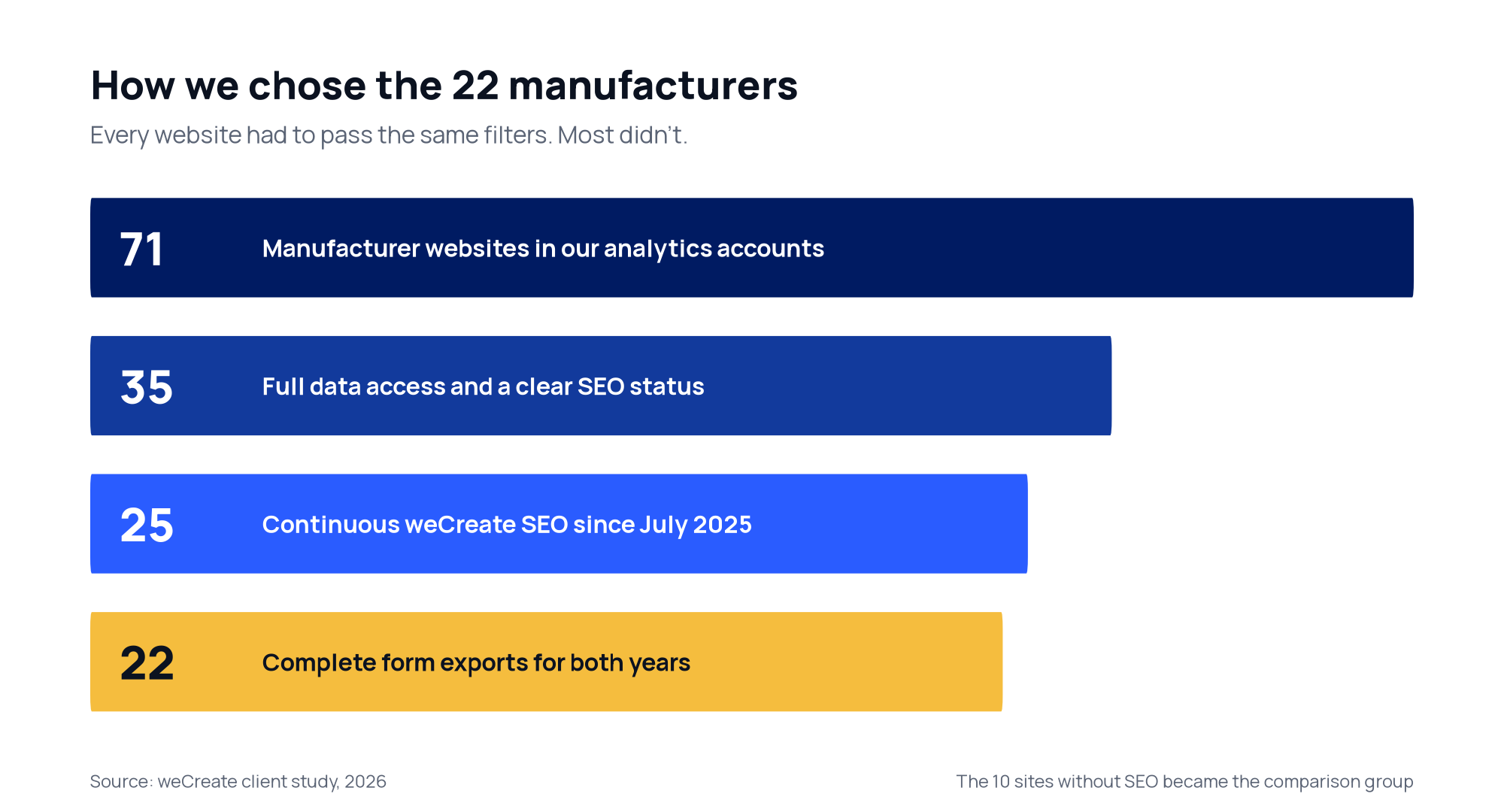
Who we included. We started with 71 manufacturer websites in our analytics accounts and applied the same filters to all of them:
The other 10 manufacturer websites had no active SEO during the period but met the other criteria applied to the study group. They became our comparison group.
Who they are. The 22 manufacturers include machine shops, plastic injection molders, metal fabricators, a foundry, a die caster, plating and coating shops, a custom transformer manufacturer, a wire manufacturer, a wood door manufacturer, a restroom trailer manufacturer and a hardwood lumber producer.
What we counted.
Limits. These are our clients, so the sample isn't random. Form counts show how many buyers reached out, not how many became customers. The comparison group is small (10 sites), so treat it as an indicator, not a precise measurement. Also note that the comparison group contains sites mostly built by weCreate, so an SEO foundation was already baked into the build. The average manufacturer site would generally perform worse than the comparison group. The full numbers are in the data table at the end of this section.
AI Overviews and chatbots now answer many searches before anyone clicks. We wanted to know whether SEO still produces leads for manufacturers under those conditions, and what happens to manufacturers who stop.
Our hypothesis had two parts:
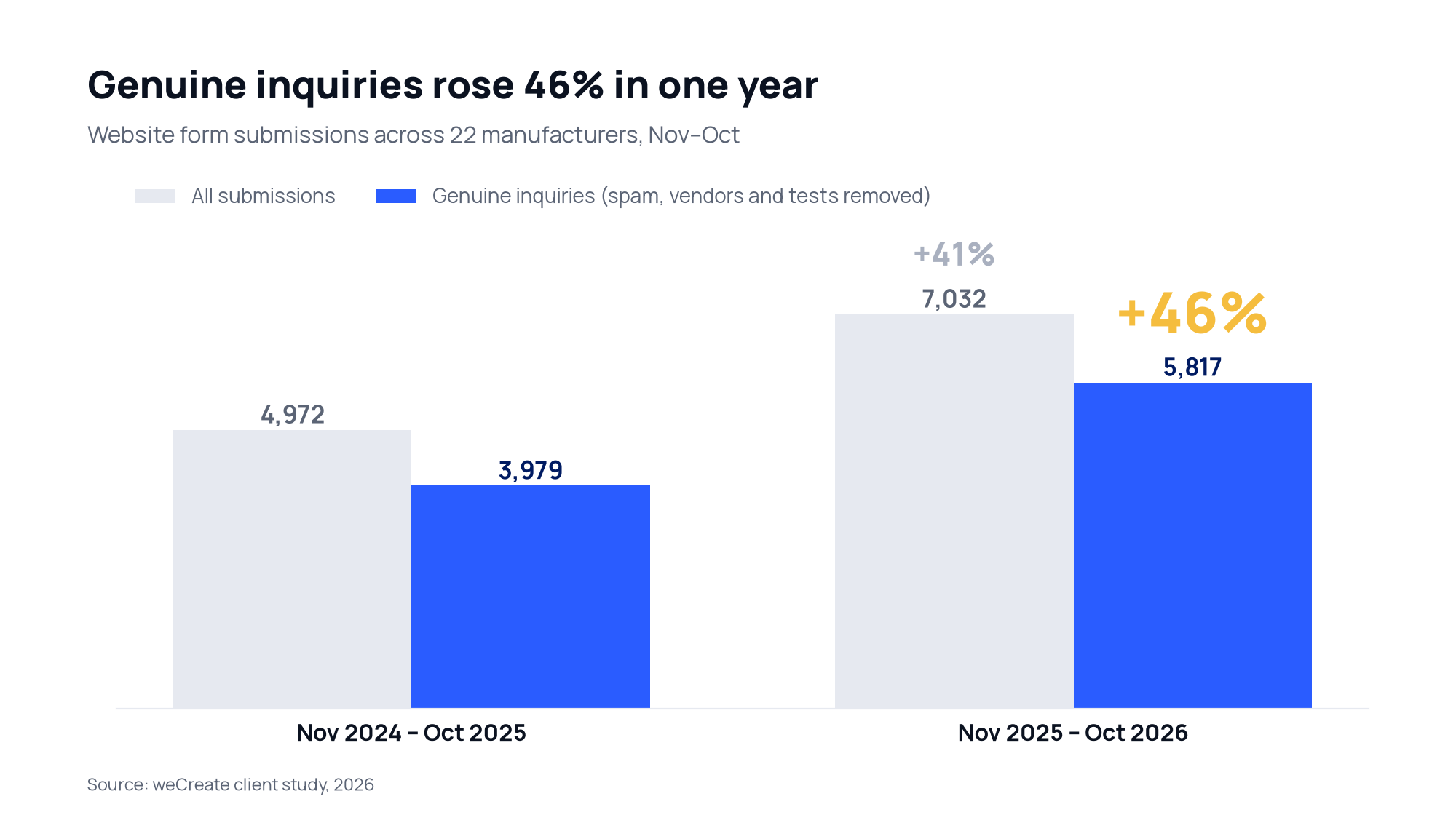
Across the 22 manufacturers, genuine inquiries rose from 3,979 to 5,817, an increase of 46%. Total submissions rose 41%, from 4,972 to 7,032.
Genuine inquiries grew faster than total submissions. The share of submissions that were real buyer inquiries went up, from 80% to 83%.

A total can hide a lot, so we also looked at each manufacturer on its own. 20 of the 22 increased their form submissions year over year. The median manufacturer grew 60%.
The results weren't driven by one large site. Half the group grew by 60% or more, including machine shops, injection molders, a transformer manufacturer and a welding and fabrication shop. The biggest gain came from a hardwood lumber producer that had almost no search visibility before starting SEO. Its submissions went from 22 to 210.
Two manufacturers declined: a non-ferrous foundry (−30%) and an industrial coatings company (−20%). We included them because leaving out weak results would make the study less useful to you.
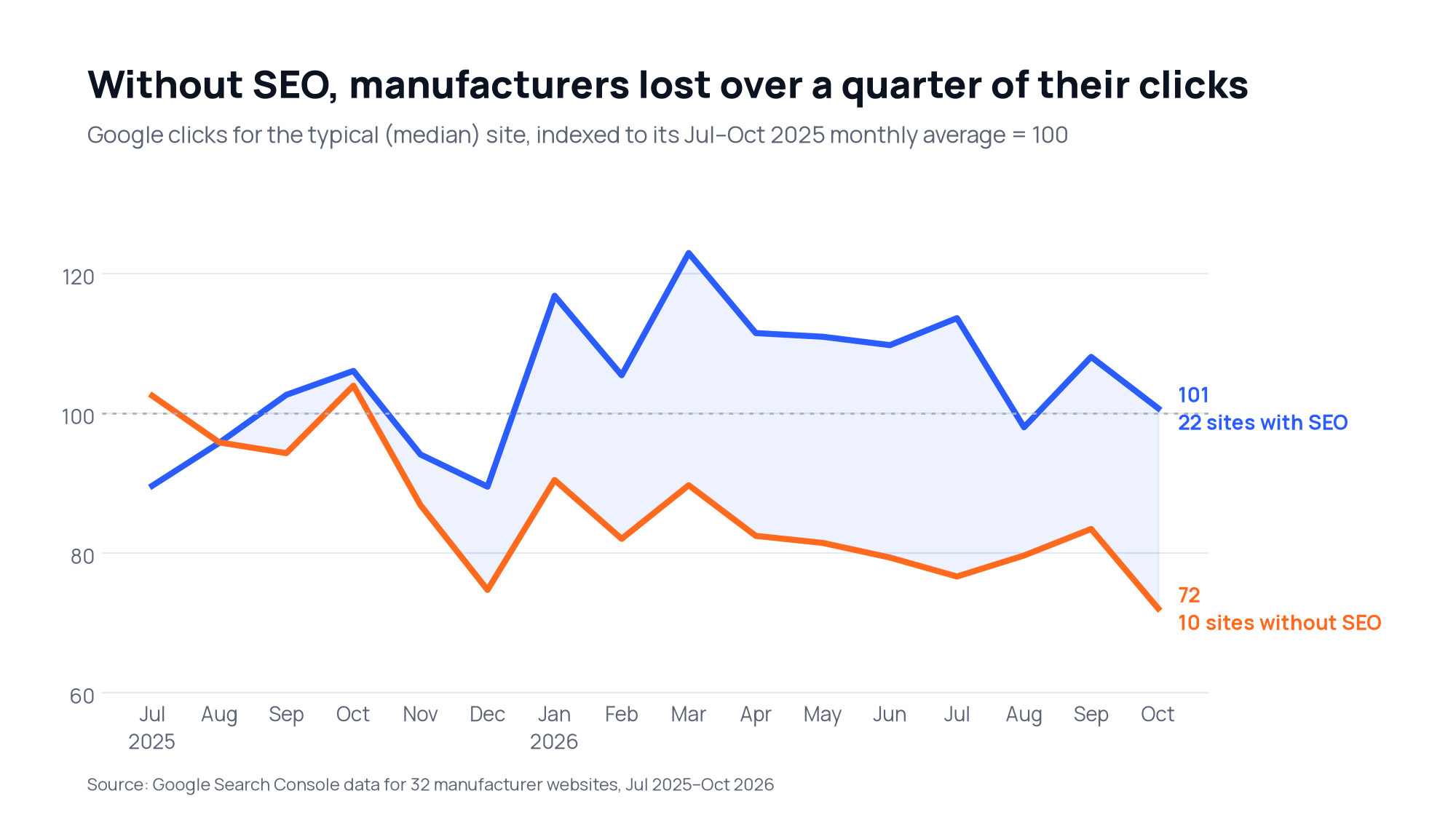
The two groups tracked together until November 2025, then split. By October 2026, the typical manufacturer without SEO was getting 28% fewer Google clicks than its July–October 2025 average. The typical manufacturer with SEO was right where it started, at 101.
Comparing July–October 2026 with the same months of 2025:
This is the gap we expected. Holding steady now takes ongoing work, and manufacturers who stop fall behind quickly.

At 13 study sites with conversion tracking, organic search was the largest source of tracked conversions at 10. The typical site got 49% of its conversions from organic search. Direct visits were usually second, and some of those come from buyers who found the company through search earlier and typed in the address later.
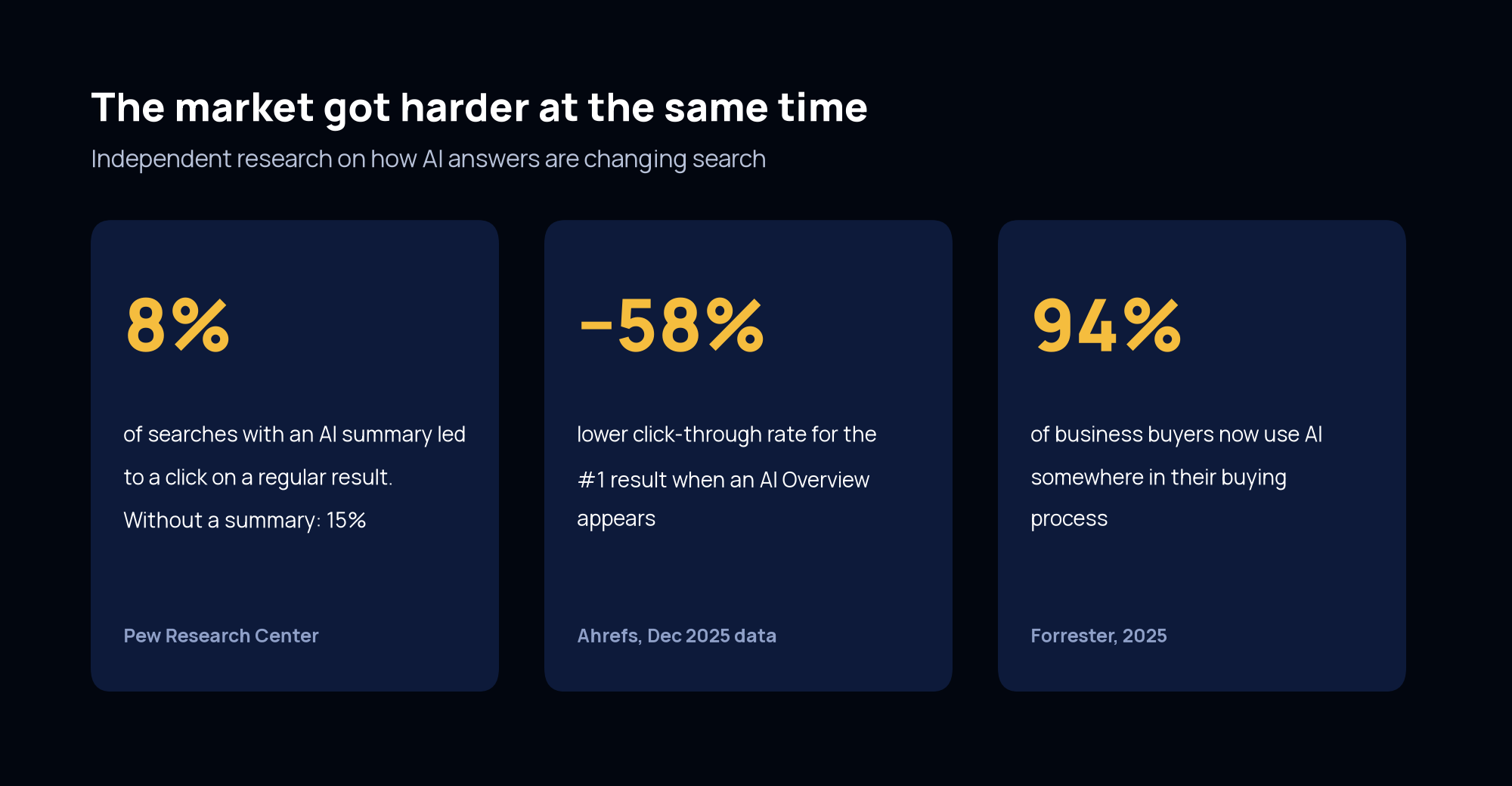
These gains came while search got harder, not easier.
Fewer clicks per search means each ranking is worth less traffic than it used to be. To keep inquiries growing, the work has changed:
What we do for each client has changed too:
If you're busy today, SEO can feel optional. The comparison group shows the cost of waiting. Manufacturers without SEO lost over a quarter of their Google clicks in a year, and that traffic is hard to win back once competitors take those positions.
Want to see how your site compares to these 22 manufacturers? Request a free SEO and AI search review or call us at 814.314.9323.
The study shows what happens across a group. These three campaigns show what the work looks like inside one company.
Where they were:
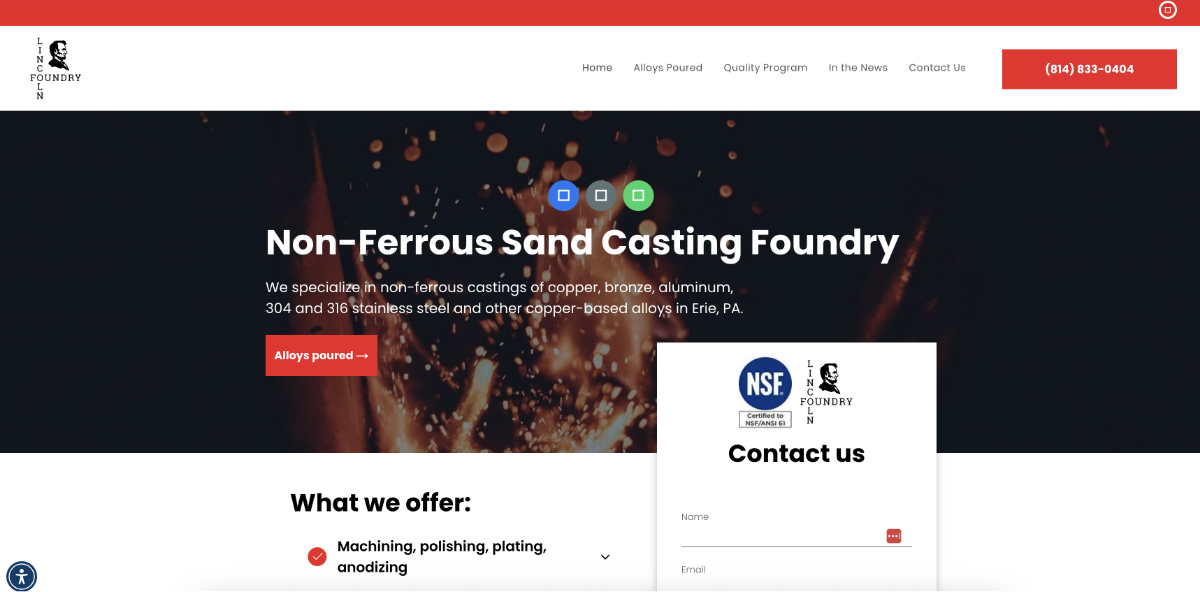
What was holding them back:
What we did:
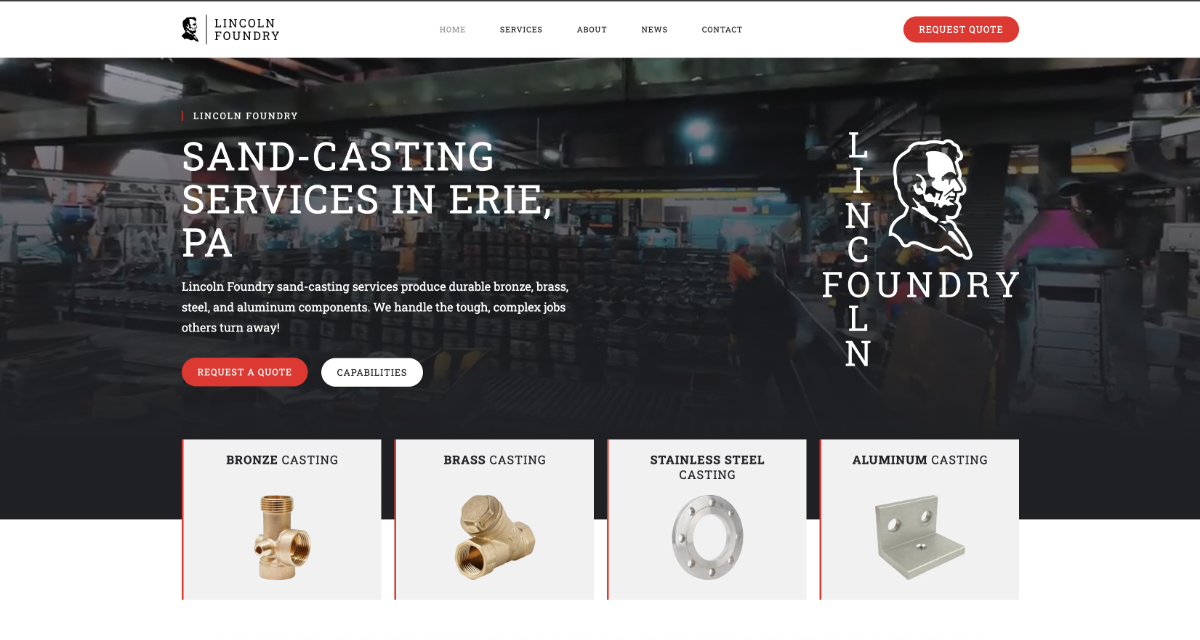
We started by designing a new site that clearly segmented their offerings by service, industry and alloy.
We put ourselves in the shoes of the person searching for Lincoln: who they are, how they talk, what matters to them. In this case we understood that many of the people searching for a metal caster worked for machine shops that needed a casting quote in order to give their final quote to an OEM. That buyer cares about casting quality, how easily it machines and how close to near net shape it arrives. They care about cost, and they've likely received very specific alloy specifications and need to know Lincoln can cast that alloy. Their search might look like "stainless steel casting services" or "AL6061 casting manufacturer," and in many cases they add a location.
With each page and each article, we pictured the searches our customers would use and placed those keywords where search engines look, so Google could match the page with the searcher.
Next, we planned a long-term approach to capturing traffic from a wide range of searches. Our content plan moved from core keywords like "bronze casting" to longer keyword sets that add an industry like "naval," a specific alloy like "C86200," or a buying factor like "low-cost" or "fast turnaround." In general, each major keyword variation needs its own page or article, which gives it the best chance of ranking.
Finally, we planned and started off-page SEO and AEO, making sure Lincoln Foundry is mentioned and linked from other relevant websites that back up our claims.
The result: With a strong base of keyword-focused, useful content and a competitive off-page presence, the leads started pouring in. Companies from around the country started finding Lincoln at the top of search results for a wide range of processes and services. At any given point in 2026, Lincoln has more than $2 million in open quotes on leads that came from our SEO program.
Profile: Seaway is a multi-location U.S. injection molder that specializes in mid-to-low volume thermoplastic molding. Many of their customers rely on their engineering, design and prototyping capabilities.
What was holding them back: Seaway had a head start many manufacturers don't. They had an attractive website that clearly stated their injection molding capabilities, along with certifications and case studies. But the site didn't show all of their capabilities or prove their credibility. A few of the gaps:
What we did:
weCreate has a long history of SEO for injection molders, so we knew what was missing from Seaway's online presence. Our first step was a deep conversation about the real value they bring to the market. As it turns out, there aren't many injection molders willing or able to take on complex design and tooling builds for short-run prototype jobs. The demand exists in well-funded medical device design, and apart from overseas providers, there wasn't much competition for this type of work.
Once we understood that, we layered in on-page optimization for the searches these medical OEMs use. We built pages and articles around terms like "injection molder with engineering and design capabilities" and optimized pages like their quality page for "ISO 13485 certified injection molding." Once we were confident search engines and AI tools understood what we wanted to rank for, we found credible manufacturing sites that would vouch for Seaway. The industry calls this backlink building, but you can think of it as credibility building. A credible company should have other credible sites referring to it.
The result: Leads from the SEO program have produced more than $1 million in tooling sales for Seaway. The past year is a good example of what holding ground looks like now. From November 2025 to October 2026, Seaway's website form submissions rose 18% (from 496 to 587) compared with the year before. Their Google clicks for July–October held even with 2025, during a stretch when the manufacturers in our study without SEO lost 19%. With fewer clicks available per search, we've focused Seaway's work on transactional searches, where a buyer is ready to request a quote and still needs to visit a supplier's site.
Where they were: Custom Engineering Co. depended on outside sales for new business.
What we did: We rebuilt the site around high-intent searches like "large-scale metal fabrication," earned niche industrial and .gov backlinks, and secured placements on ThomasNet and Engineering.com.
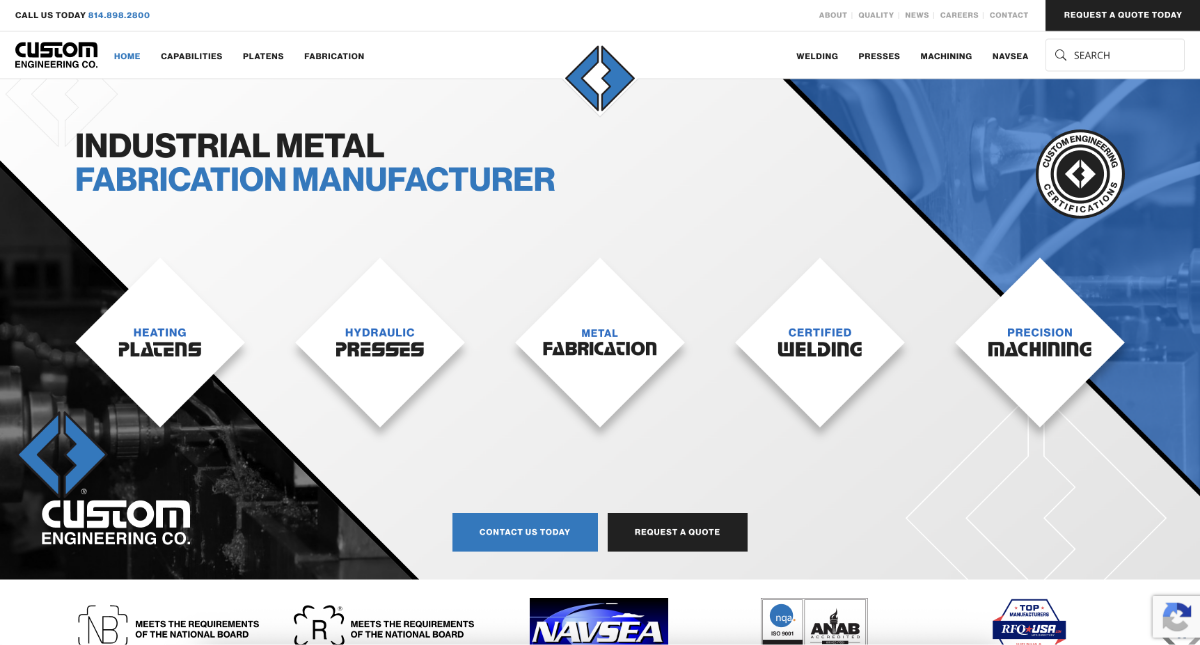
The result: In the last year, Custom Engineering tracked $2.8 million in leads from organic search. One web inquiry turned into a $750,000 defense contract, and project inquiries of $500,000 to $1 million or more now come in through the website.
"Over the past 6 months we've had over a million dollars worth of inquiries through our website. The weCreate team is the best!" Troy Miodus, Custom Engineering Co.
SEO starts with a simple fact: for almost any manufacturing service, someone is looking for a qualified provider on a search engine right now. Here are real searches we pulled from Google Search Console:
People search terms like these every month, and most of them are in the market for the service they typed in.
When we do SEO, we use Google Analytics to track conversions. A conversion might be: "When someone on the iron forging page submits an RFQ form, record it." We can then see where that person came from (organic search, direct, social or paid search). If they came from organic search, our work to rank the company for "iron forging manufacturer" directly produced that lead.
That's how we measured the 2026 study above. At 10 of the 13 study sites with conversion tracking, organic search was the largest source of conversions.
If you search "SEO for manufacturing companies," you'll find a hundred articles full of technical terms that make it seem impossible to do anything on your own. It isn't. If you get two things right, you've covered most of what matters:
It's possible, though rare, to rank content without backlinks. It's impossible to rank without content, so we'll start there. A third area, technical SEO, is covered after backlinks. For most manufacturers it's a fix-it-once job.
Each distinct thing a buyer might search for deserves its own page. For most manufacturers that means:
Give each page one main keyword. If two pages target the same search, they compete with each other and both tend to rank lower.
Keyword selection is the most important part of on-page SEO. Pick the wrong keyword and it may be too competitive to ever rank, or it may not be what your customer actually searches. A quick guide:
Google needs to see the keyword you want the page to rank for in a few important places. Most website platforms have fields for these. In WordPress, an SEO plugin like Yoast or Rank Math adds them. In Webflow, they're in each page's settings. In order of priority:
1. Your SEO title. This is the clickable headline in search results, and it also shows in the browser tab.
2. Your meta description. This is the short summary below the SEO title in search results. It doesn't directly affect ranking, but a clear one gets more clicks.
3. Your page heading (H1). This is usually the largest text on the page. Each page should have one.
4. Your content. Use the keyword in the first paragraph and in at least one subheading, then write naturally. You don't need to repeat the exact phrase a set number of times. Variations like "ways to get customers for machine shops" help, because Google's SEO Starter Guide notes that natural variation gives you more chances to show up, and that excessive repetition is keyword stuffing, which is against Google's spam policies.
There's also no magic word count. Google says it doesn't have a preferred word count. Write enough to fully answer what the buyer needs: your capabilities, tolerances, materials, certifications, lead times, industries served and how to request a quote. For competitive topics that usually takes more words than your competitors use, simply because you're covering more.
AI tools quote pages that answer questions directly. A few habits help both Google and AI:
A backlink is a link from another website to yours. If you're a member of your local manufacturers association and they list members with links to their websites, that's a backlink.
Good content alone usually isn't enough to rank, because many other sites have pages built for the same keywords. Google uses authority, which comes largely from backlinks, to decide which site is the most credible result. That makes sense. Backlinks are votes of credibility. If a respected organization like a manufacturers association links to your site, it means something.
Each website, and each page on it, has its own authority, so measure it before you go to the trouble of getting the link. We use Majestic's Trust Flow, which scores how closely a page is connected to trusted sites. We look at the Trust Flow of the specific page that would link to you, not just the domain, because a strong website can still link to you from a weak page.
Relevance matters as much as strength. A link from a manufacturing association, an industry publication or a supplier's partner page is worth more than a link from a general website with a higher score.
Backlink building is one of the harder tasks for beginners because there are many ways to find links and they aren't all equal. We use two main approaches:
Other reliable sources for manufacturers include industry directories, trade publication features, trade show exhibitor lists, local economic development groups, university and workforce partnerships, and podcast or webinar appearances.
A word of caution: Google's spam policies treat links created mainly to manipulate rankings as link spam. Paying for a membership, listing or sponsorship is normal. If you pay specifically for a link, Google expects it to be marked as sponsored. Stay away from link networks that sell placements across many sites.
Most good backlinks cost something. Joining an industry association may cost several thousand dollars a year, but it's one of the best investments you can make. You get the backlink, the credibility and the relationships.
Companies that specialize in manufacturing SEO, like weCreate, have backlink sources that most manufacturers don't know about. We keep the full list for clients, but here are two to start with.
Tristate Manufacturers Marketplace. Full disclosure: weCreate is a partner of Tristate Manufacturers Marketplace. Manufacturers in Pennsylvania, New York, Ohio and West Virginia can join. Every membership level includes a company profile that links to your website, and the top level (still cheaper than most associations) lets you publish articles throughout the year. The marketplace also sends leads directly to members when a buyer needs help finding a supplier. Sign up for Tristate Manufacturers Marketplace
Manufacturing podcasts. Guest appearances on industry podcasts give you a link from the episode page, a recording you can put on your own site and a brand mention that AI tools pick up. Nate hosts Manufacturing Insiders, and we're always looking for manufacturers with a good story to tell.
Technical SEO makes sure Google can find, read and trust your pages. It isn't where most rankings are won, but problems here can hold everything else back. Check these:
Google's guidance is that some changes take effect in a few hours and others take several months. In our experience, most clients see early movement in rankings within the first 90 days, with qualified lead growth building over 4 to 12 months. Timing depends on your competition, your current site and your authority.
SEO also compounds. Pages you publish this year keep working next year, which is why the manufacturers in our study held their clicks while the comparison group lost them.
Traffic is a starting point, but the goal is quote requests and revenue. Here's how to track what matters:
Most agencies offer monthly SEO packages between $2,500 and $5,000 a month. weCreate is typically at the lower end of that range, and we have smaller packages for small manufacturers.
DIY SEO is very possible if you can use Google Search Console for keyword research, write strong content and use a tool like Majestic or Ahrefs to study competitor backlinks and do outreach. These tasks take time and practice. If you can't commit at least 8 hours a month, hire an agency. weCreate also offers consulting to help in-house marketing teams get started.
Ask any agency you're considering:
Learn more about weCreate's manufacturing SEO services.
If you want measurable, steady lead generation, you need to be doing SEO. Our 2026 study shows it still works. Genuine inquiries rose 46% across 22 manufacturers, while manufacturers without SEO lost over a quarter of their Google clicks. It also shows that the work is harder than it used to be, and standing still now means falling behind.
Most manufacturers are too busy running their business to publish content regularly or buy and learn backlink tools. You now know enough to move the needle on your own: optimize your existing pages for the right keywords and look at your existing relationships for backlink opportunities. If you want help, weCreate would like to talk (no surprise, that's why we wrote this). We work with manufacturers across the country and around the world. If you don't want fully managed SEO, we also offer consulting to help your internal team do it well.
Request a free SEO and AI search review or call us at 814.314.9323.
weCreate is about 90% focused on manufacturing. Our projects often start with a website design. That isn't always the case, but if SEO is bringing buyers to your site, we want to make sure the design and content turn those visits into inquiries.
Industrial SEO usually refers to SEO for service-based or contract manufacturers. Manufacturing SEO includes that group plus OEMs and product manufacturers. The fundamentals are the same, but how we present content and pursue backlinks often differs between OEMs and manufacturing service providers.
There are differences, but companies that do an outstanding job with SEO usually perform well in AI search too. ChatGPT, Perplexity and Google's AI Overviews look for credible pages that answer the buyer's question, and they lean heavily on search engine results and the sites that rank well in them. That leads back to the same on-page and off-page work. AEO adds content written for direct answers and more mentions on third-party sites. See our AEO services for manufacturers.
Manufacturers that don't sell through distributors or to the government usually benefit the most. But no matter how a manufacturer sells, ranking higher for its core offerings almost always helps.
Most agencies charge between $2,500 and $5,000 a month. weCreate is typically at the lower end of that range, with smaller packages for small manufacturers.
Most clients see early ranking movement within the first 90 days, with lead growth building over 4 to 12 months. Competition, your current site and your authority all affect timing.
A new website should lay the foundation, with a focused page for each distinct service or product and proper redirects from old pages. That foundation still needs ongoing content for long-tail searches and off-page SEO to perform.
Quality beats frequency. One complete, useful article a month is better than an incomplete one every week. Most companies see strong results from monthly publishing.
Yes, if you can do keyword research in Google Search Console, write strong content and analyze competitor backlinks with a tool like Majestic or Ahrefs. Plan on at least 8 hours a month. If you can't commit that, an agency is the better choice.
If you're a Tier 1, Tier 2 or Tier 3 manufacturer, there are almost always people in your target market searching for what you offer. If people are searching, SEO can work for you. The problem was likely that the agency didn't understand your offerings, your ideal customer or SEO best practices.
Both can generate leads. SEO improves the value and visibility of your website in a way that lasts, even after you stop investing. PPC only works while you're paying for it.
First, learn the exact searches buyers use for your products and services. Second, find a person or agency that can write complete, accurate pages and articles on those topics. Third, set a budget for memberships, partnerships and promotion that lead to backlinks. Fourth, make sure someone can handle technical SEO like site speed, redirects and schema markup.
Have a question this article didn't cover? Reach out.